
By I. Kuntz, K.W. Powers, C.S. Hsu, and K.D. Rose
https://doi.org/10.1002/masy.19880130124
The study of polymerization processes reveals fascinating insights into the creation of materials used in everyday products. A notable example is the copolymerization of isoprene with isobutylene, a process explored in-depth by researchers I. Kuntz, K.W. Powers, C.S. Hsu, and K.D. Rose. Their research, published in Makromol. Chem., focuses on the formation of cyclic oligomers, specifically C13H24 and C21H40.
Key Findings
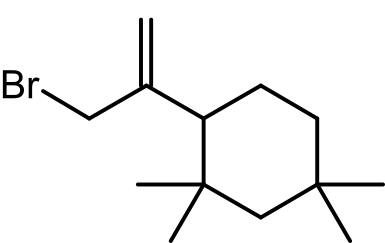
- Identification of Oligomers: The study identified two major cyclic oligomers, C13H24 and C21H40, formed during the copolymerization process. The C13H24 oligomer was confirmed as 1-isopropenyl-2,2,4,4-tetramethylcyclohexane using mass spectrometry and NMR.
- Mass Spectrometry Analysis: The mass spectrometry analysis revealed key fragmentation patterns. Loss of a methyl radical gives the m/z 165 cation. Ring opening of the molecular ion and ion migration, followed by the loss of an isopropenyl radical, results in the m/z 137 cation. Loss of isobutylene produces the m/z 124 radical ion, which upon losing a methyl radical forms the m/z 109 cation. These patterns provided crucial information for elucidating the structure of the oligomer.
- NMR Confirmation: NMR analyses further validated the structure by showing clear correlations between carbon and proton resonances. This comprehensive approach confirmed the identities of the oligomers and their structural details.
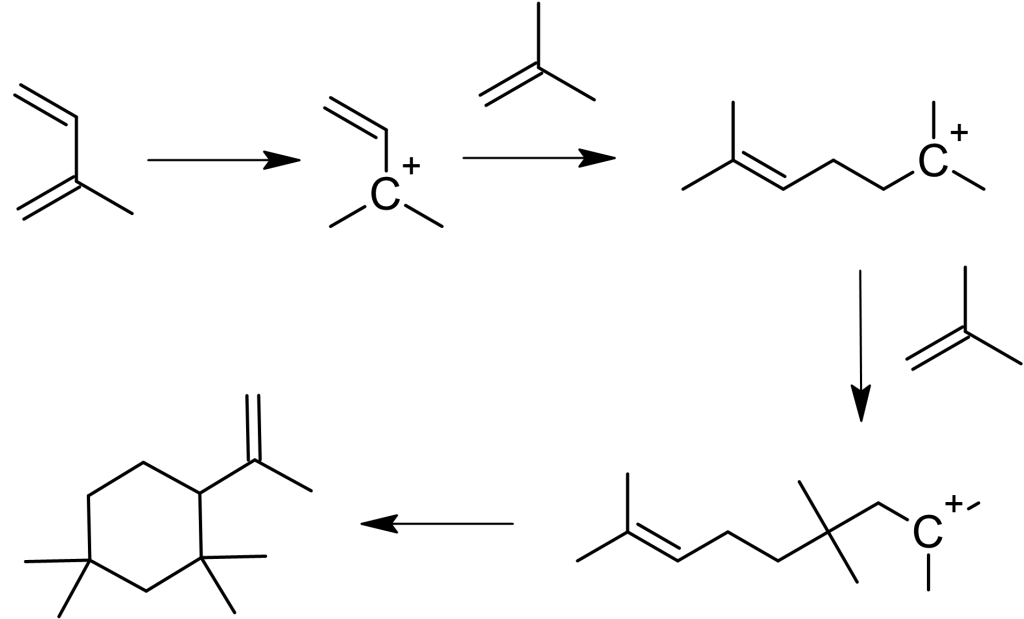
- Proposed Mechanism: The researchers proposed a mechanism where protonation of isoprene initiates the formation of cyclic oligomers. This is followed by the addition of isobutylene molecules and subsequent cyclization, forming the stable oligomer structures observed.
Conclusion
This study enhances our understanding of the chemical processes involved in polymerization, particularly the formation of cyclic oligomers. The insights gained from this research are crucial for developing and improving materials like butyl rubber, which is widely used in various industrial applications.
For a deeper dive into the intricate details of this study, refer to the full article by Kuntz and colleagues in Makromol. Chem.
